For adults and teens.
Written by Ms. Finnigan (Ellen Finnigan), founder of Teach to the Text
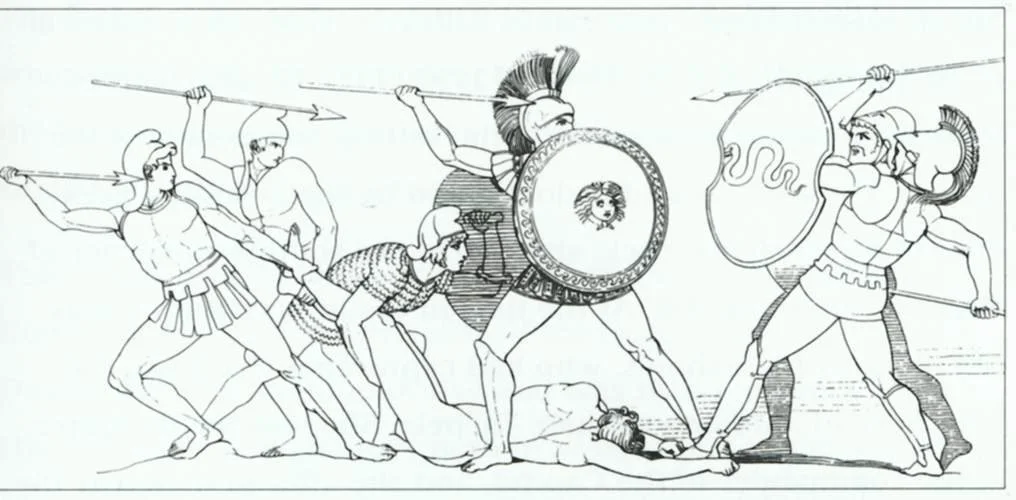
The fight over the body of Patroclus. John Flaxman, engraved by Tommaso Piroli, The Iliad of Homer, 1793. (More about this image at the end of the post.)
Sometimes one great poem is worth a million homilies.
Here are ten reasons to read Homer's Iliad, whether you're a parent, a teacher, or a teenager.
1. Because The Iliad is our first book.
The Iliad is an epic poem composed by Homer around 850 B.C., around the time the Greek alphabet was being invented. The story is set during the Trojan War, which probably happened in the late Bronze Age, around 1250 B.C. The story had been passed down for hundreds of years by the ancient Greeks' early ancestors, the Mycenaeans, by the time Homer wrote it down. If you are going to read one work of literature this year, why not see where it all began?
2. Because Simone Weil once wrote: “Nothing that the peoples of Europe have since produced has been worth the first poem to have appeared among them.”
Nuff said!
3. Because poetry is a branch of knowledge.
If you go to the Stanza della Segnatura in the Vatican's Apostolic Palace, you can look up and see four frescoes that Raphael painted representing the four branches of knowledge: philosophy, theology, poetry, and law. “The Parnassus” depicts Apollo, the god of music and poetry, along with the Muses. Homer is there on the left in royal blue. (He is depicted as being blind.)
Why is poetry considered a branch of knowledge? Perhaps William Carlos Williams said it best:
It is difficult / to get the news from poems / yet men die miserably every day / for lack / of what is found there.
When was the last time you read poetry?
4. Because The Iliad reminds us of the effects of sin, specifically the sin of wrath.
If you have a short temper, lash out at people, and hold grudges...
If you too frequently ruminate on the weaknesses of others...
If you have ever done anything out of spite just because you felt “dissed”...
If you have ever thought to yourself, “I'll show them!”...
...then first of all, join the club!
Wrath stems from pride, the mother of all vices. Sometimes one great poem is worth a million sermons. This poem might just save your life, by reminding you of the possibility of spiritual death. It might help you get over that thing, that thing you've been obsessing about. You know the one...
5. Because you need a dopamine detox.
Most of us have spent the last 10–15 years with a terrible addiction. Our lives are nothing but time, and oh, how we've piddled it away! Our powers of concentration are totally shot. It's so hard to pick up a book and read anymore, isn't it?
But I am tired of blue light. I am sick of scrolling through “content,” hunched over some device, engaging in the passive and solitary consumption of information. I am sick of listening to podcasts, too, to other people's conversations. I want to have great conversations again, with other people! I want to think about what is timeless, universal!
But reading, especially reading epics, is hard. That's exactly why you should do it. And do it in a group. There will be some accountability built in. Engage your brain! Reclaim your life! De-zombify!
6. Because you will set an example for your children and grandchildren.
If you want the people who look up to you to read, you have to read. If you want them to grow up to become lifelong learners, you have to model lifelong learning. Better yet, read it with them. Western culture is a Great Conversation. Join it. Dive in together! If nothing else, you can tell your children or grandchildren about what you are reading, and maybe one day they will want to read it too. This is how we preserve our culture: not by digitizing every library, but by telling the great stories again and again, in joy and in remembrance, in fear and in trembling.
7. Because war has always been totally evil and totally dumb.
Some people might disagree with me on this, but I think it's true. The Trojan War supposedly started because one guy ran off with another guy's wife. Thousands of men fought for ten years, and the war destroyed the entire Mycenaean world somehow. My students always say: “This war is so dumb!” They are right, for one reason because it is so grotesquely out of proportion.
Homer is realistic, showing us exactly how war becomes a perpetual motion machine of evil, and why it is so hard to stop once it starts. In the words of Simone Weil: “A moderate use of force, which alone would enable man to escape being enmeshed in its machinery, would require superhuman virtue, which is as rare as dignity in weakness.”
G.K. Chesterton once wrote: “The Iliad is only great because all life is a battle, the Odyssey because all life is a journey, the Book of Job because all life is a riddle.” But I disagree with Chesterton, somewhat, here. The Iliad is only great because it shows the futility and folly of war. Of course life is a battle and we must engage in spiritual warfare, but spiritual warfare is never futile, so it's not a good metaphor.
8. Because classical literature gives you perspective.
We all need perspective. Perspective is good for mental health. As Ecclesiastes 1:9 puts it: “What has been will be again, what has been done will be done again; there is nothing new under the sun.”
9. Because, if you are a Christian, classical literature can deepen your appreciation of Christianity and help you grow in faith.
“Behold, I am about to do something new; even now it is coming. Do you not see it?” (Isaiah 43:19)
“And he who was seated on the throne said, ‘Behold, I am making all things new!’” (Revelation 21:5)
One can see how Jesus Christ brought something entirely new to the table.
10. Because cultural literacy is awesome.
Homer only wrote two books, so once you've read The Iliad, you can read The Odyssey and go around saying, “I've read the complete works of Homer.” (It sounds impressive. You don't have to tell people that he only wrote two books!)
In summary
By reading The Iliad, you can reclaim your cultural heritage and be empowered by the knowledge it provides. You can take back your brain from the tyrants of tech, those greedy little thieves of your precious time and attention. You can join the Great Conversation while setting an example of lifelong learning for those around you. You can reflect on the role of violence in this world, and you might even discover new dimensions of your faith. You might even decide to finally put aside your anger and surrender that thing that is dead which you are still holding on to, and by doing so, choose life: your one, unique, precious, eternal and non-repeatable life!
Your next step
Ready to start? Read The Iliad book by book, at your own pace or with your teen.
For Lifelong Learners: About the Image
This drawing is by the English sculptor John Flaxman, engraved by Tommaso Piroli for an illustrated Iliad published in 1793. It shows the fight over the body of Patroclus in Book 17. Patroclus died wearing Achilles' armor, fighting in his place, because Achilles was still sulking in his tent. That is wrath at work: the cost of Achilles' anger is paid by the friend he loved most.
Flaxman's spare outline style was inspired by the figures on ancient Greek vases, and his Homer drawings were admired all over Europe.
Image: John Flaxman, engraved by Tommaso Piroli, The Iliad of Homer, 1793. Bibliothèque nationale de France.