Two short sketches, and a third option.
Written by Ms. Finnigan (Ellen Finnigan), founder of Teach to the Text
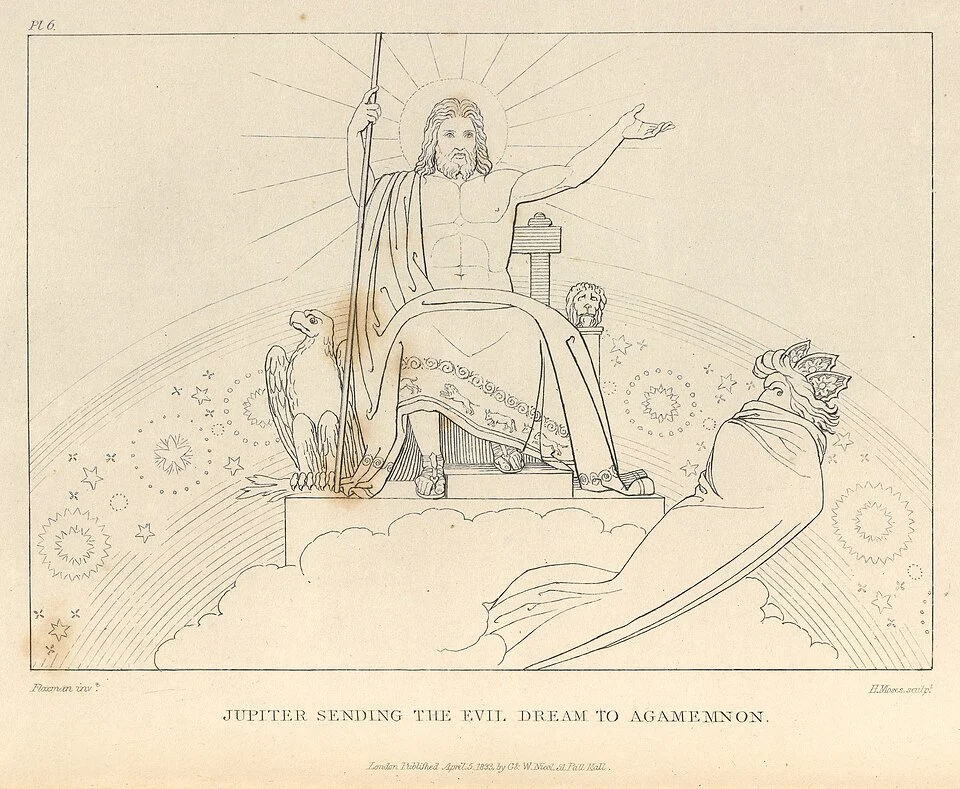
Jupiter Sending the Evil Dream to Agamemnon, after John Flaxman (1834). (More about this image at the end of the post.)
Students can’t discuss what they don’t understand.
I love hybrid schools. I started my teaching career at one, and I’ve seen what a classical hybrid school makes possible: real friendships, families who stay at the heart of their children’s education, and the perfect setting for Socratic discussion.
But sustaining all that in the high school years is hard. So I wrote two short sketches. The first is the hybrid we all dream about. The second is the one most of us actually work in.
See if you recognize yourself in either one.
The Dream
Imagine a hybrid where every freshman has already mastered the “grammar” and “dialectical” stages of learning.
All students show up ready to read the Great Books at home, supported by parents who can carry on conversations about them at the dinner table. Part-time teachers waltz into the classroom with only a book in hand (no PowerPoint), prop their feet up on the desk, and stroke their chins for a few minutes, before firing off some questions, to which students respond readily and fluently, practically fighting for their chance to speak. Teachers ask follow-up questions that not only uncover flaws in the students’ logic, but require students to express themselves with more precision and grace. Carrying on this kind of Socratic dialogue comes easily for part-time teachers who are so well read, so intimately familiar with the content, and so well rested!
Teachers do little work. Lesson plans, quizzes, and tests are considered vestiges of modernist, factory-style learning systems. Who needs to assess mastery when students are so naturally eager to learn, and their progress so evident? Here, teachers require little by way of compensation. One teacher, a classics professor, even teaches for free: He finds the brisk walk over from the leafy campus next door, where he has tenure, to be revitalizing in the middle of the day!
When the bell rings, teachers verbally rattle off the next assignment (which all students diligently record in their notebooks). Students scurry home to write essays in which they further grapple with the ideas uncovered in class. Papers flow easily from teeming minds. Wikipedia, Grammarly and ChatGPT are never “consulted,” and parents and students never feel the need to email the teacher for clarification or help.
The work students do here fuels their intellectual, personal, and spiritual growth. Teachers have ample time to devote to their personal lives and intellectual interests, which in turn enhances their teaching. While they must set aside an hour here and there to read student papers, it is pleasurable work, because student papers are so well-written and so interesting. Occasionally, a teacher might write in red pen: “See me after class!” — only to steal a few minutes to congratulate a student on a job well done.
Parents are always happy, and administrators spend their days reading for pleasure, emerging only at graduation to lavish the students with honors and praise.
The Reality of a Classical Hybrid School
Meanwhile, back on planet Earth...
Hybrids are designed to keep the heart of education in the home. Students expect to work more independently and parents agree to help. This is wonderful! But...
Most freshmen don’t have very good reading comprehension skills.
Parents who are unfamiliar with the classics feel ill-equipped to help.
Excellent teachers can make a world of difference, but...
Hybrids must hire from a local population.
Even adults who have read the classics might not know how to teach them.
By the time a teacher learns the ropes, she might move, have a baby, or change careers.
Even if the perfect teacher can be found, students can’t discuss what they don’t understand. So classes end up being a series of lectures that “cover the material.” (Snore!)
Poorly written papers are extremely time-consuming to grade.
Teachers nix essays, understandably, to establish “work-life balance.”
Students miss out on the writing practice they need to improve.
Instead of essays, teachers use (mostly auto-graded) exams for assessment.
Exams are based on lectures and what was “covered” in class.
So students learn they can pass the tests without even reading the books!
Though students are working less, “good grades” create an illusion of learning.
Classical hybrids must either a) do more for the high school students to help them along, or b) lower expectations and water down curriculum. If the hybrid does neither, students will “panic” and start using technological crutches just to get by (i.e. they will cheat). Now, not only are students not doing the hard work required to develop strong mental skills, they are learning all the wrong lessons about what it takes to succeed in the world and compromising their integrity in the process.
If a teacher writes “See me after class!” on a student paper, it might be because the student isn’t even using paragraphs. If the student is a junior, there is little time left to get him on track.
This is nobody’s fault! Even when parents, students, teachers and administrators have the best intentions, practical realities create natural incentives that lead to predictable behaviors — and the same disappointing results.
Is there an option C?
I believe there is: co-teaching.
What if your on-site teacher didn’t have to do “all the things”? In a co-teaching arrangement, I serve as a remote “master teacher.” Students watch my lectures, work through my study guides, and take my quizzes at home, so they come to class having actually read the book.
Your teacher keeps what only she can do: leading discussion, grading writing, and knowing her students.
That’s how a classical hybrid can keep its high standards without burning out its teachers, or expecting parents to teach Homer at the kitchen table.
It may not be the Dream. But it’s a lot closer!
Your next step
Want to see how co-teaching could work at your school or co-op? My text studies of The Iliad and The Odyssey were built for exactly this.
Or book a call with me to talk it through.
For Lifelong Learners: About the Image
In Book Two of The Iliad, Zeus sends Agamemnon a dream. It tells him that if he rallies the Greeks, he will take Troy that very day. Agamemnon believes it, and things do not go as the dream promised.
This engraving of the scene comes from an 1834 London edition of The Iliad and the Odyssey, illustrated with line engravings after the English sculptor John Flaxman (1755–1826) and engraved by Henry Moses. Flaxman worked out his spare outline style in Rome in the 1790s, drawing figures mostly in profile in the manner of Greek vase painting, and leaving wide spaces of white paper around them.
I’ll admit the choice is a little tongue-in-cheek. The classical hybrid is inspired by a good dream, not an evil one! But of course we have to be realistic and always acknowledge our limitations.
Jupiter Sending the Evil Dream to Agamemnon. After John Flaxman, engraved by Henry Moses. From The Iliad and the Odyssey, London, 1834. The Metropolitan Museum of Art. Public domain.